
Calculate, Verify, and Act with Confidence
A product carbon footprint measures the total greenhouse gas emissions generated across a product lifecycle. Clearyst° provides the consulting expertise that makes PCF software produce credible, defensible results, then uses those results to drive decarbonization efforts.
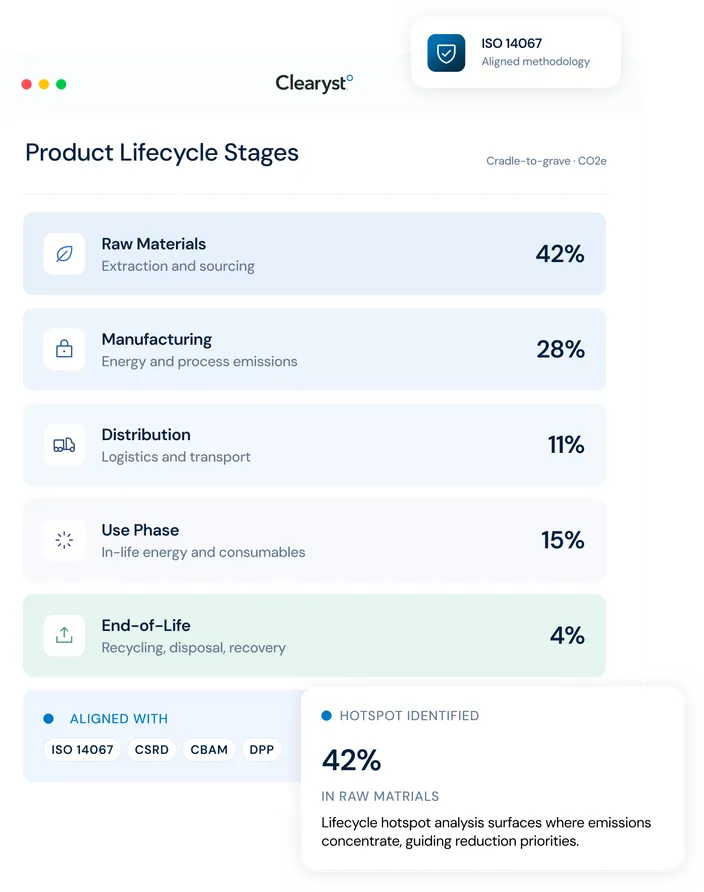
What Is a Product Carbon Footprint?
Customers, regulators, and investors are now asking for product-level carbon data, not just corporate emissions totals. Many companies have started Scope 1, 2, and 3 reporting, but product carbon footprinting is often the next challenge. The difficulty is not access to tools. It is applying the right methodology, aligning internal teams, and producing results that hold up under scrutiny. A product carbon footprint quantifies the total greenhouse gas emissions associated with a specific product across its lifecycle, expressed in CO2 equivalent. It is calculated using life cycle assessment methodology and standardized under ISO 14067, the global reference standard for product carbon footprints.
Corporate Carbon Footprint vs. Product Carbon Footprint
A corporate carbon footprint measures emissions across an entire organization, including Scope 1, 2, and 3. A product carbon footprint measures emissions tied to a single product across its lifecycle.
| Corporate Carbon Footprint | Product Carbon Footprint | |
|---|---|---|
| Scope | Measures emissions across an entire organization, including Scope 1, 2, and 3 | Measures emissions tied to a single product across its lifecycle |
| Purpose | Supports regulatory disclosure and investor communication | Supports customer requirements, procurement decisions, and regulatory programs such as CBAM and Digital Product Passports |
Companies typically need both. A strong corporate Scope 3 foundation often accelerates product carbon footprinting, since supplier and materials data can be reused.
Cradle-to-Gate vs. Cradle-to-Grave
Product carbon footprints are defined by system boundaries:
Cradle-to-Gate
Covers raw materials through manufacturing. Commonly used for B2B products and CBAM reporting.
Cradle-to-Grave
Includes full lifecycle through use and disposal. Required for consumer-facing disclosures and ISO 14067 verification.
Cradle-to-Cradle
Extends to circular material flows and recyclability.
Selecting the right boundary depends on regulatory requirements, customer expectations, and how the data will be used.
Why Product Carbon Footprinting Matters Now
Customer Requirements
Enterprise buyers increasingly request PCFs as part of supplier qualification and procurement processes.
CSRD and EU Regulations
Product-level emissions data is required where material, supported by ISO 14067 methodology.
CBAM
Importers must report embedded carbon in regulated products entering the EU.
Digital Product Passports
Emerging requirements across electronics, textiles, and packaging.
Decarbonization Strategy
Product-level data identifies emissions hotspots and informs design and sourcing decisions.
For many organizations, product carbon footprinting is becoming as important as corporate emissions reporting. If your customers are asking for product-level data, the expectation is not estimates. It is defensible, documented results.
PCF Platforms We Work With
PCF software accelerates calculation. It does not replace expert judgment. Clearyst° provides the methodology, data validation, and internal alignment required to ensure outputs are accurate and defensible.

Automated PCF at scale. Designed for large-scale product carbon footprinting, particularly for companies with complex product portfolios.
- Automates bill of materials integration and lifecycle modeling
- Enables rapid PCF calculation across large product sets
- Supports regulatory outputs aligned with CSRD and CBAM
- Identifies material and process hotspots

Clearyst°'s advisory role: evaluates fit, defines methodology, reviews data quality, and ensures outputs are aligned with ISO 14067 and business objectives.

AI-powered carbon intelligence. Connects corporate and product carbon data in a unified platform.
- Integrates with enterprise systems across finance, procurement, and operations
- Supports Scope 3 and PCF calculations in one environment
- Uses AI to streamline data collection and analysis
- Includes CSRD-aligned reporting capabilities
Clearyst°'s advisory role: aligns implementation with reporting requirements, internal processes, and cross-functional teams.
Why Consulting + Software Delivers Better Results
Defines System Boundaries and Methods
Defines system boundaries and calculation methods appropriate to your product and use case.
Validates Data Quality
Validates data quality and fills gaps appropriately, rather than defaulting to generic factors.
Aligns Stakeholders
Aligns stakeholders across product, procurement, and sustainability teams around one methodology.
Translates Results Into Strategy
Translates results into decarbonization strategy, not just a compliance artifact.
The result is a PCF report that can be shared, verified, and used.
How Clearyst° Calculates Product Carbon Footprints
Clearyst° calculates product carbon footprints through a structured, ISO 14067-aligned process that connects data, methodology, and business action.
Platform Recommendation and Scope
Assess your products, systems, and requirements. Recommend Arbor or Greenly. Define system boundaries and lifecycle scope.
Data Collection and Alignment
Collect bill of materials, supplier data, manufacturing energy use, and logistics data. Align internal teams across product, procurement, and operations.
Emissions Calculation
Apply ISO 14067 methodology using Arbor or Greenly. Calculate emissions by lifecycle stage. Identify hotspots.
Reporting and Verification Preparation
Produce structured PCF reports with full documentation. Prepare for ISO 14067 verification and customer or regulatory review.
Decarbonization and Circularity Strategy
Translate results into actionable reduction priorities across materials, suppliers, and processes.
This approach ensures that product carbon footprints are not only calculated, but also usable for decision-making.
Our PCF Services
Platform Recommendation and PCF Scope Design
Clearyst° evaluates business needs and recommends the right platform and approach.
- Define system boundaries and functional units
- Select appropriate calculation methodology
- Align with ISO 14067, CSRD, CBAM, and customer requirements
This ensures that the program starts with the right structure.
Data Collection and Supplier Engagement
Accurate PCFs depend on high-quality input data.
- Map materials and energy inputs across the lifecycle
- Identify where primary supplier data is required
- Engage suppliers for emissions data collection
- Cost and supply chain continuity
Better data leads to more reliable results and stronger audit outcomes.
ISO 14067-Aligned PCF Calculation and Reporting
Clearyst° calculates and documents product carbon footprints in line with international standards.
- Calculate emissions by lifecycle stage
- Perform hotspot analysis
- Document methodology and assumptions
- Prepare outputs for regulatory and customer requirements
The result is a PCF report that can be shared, verified, and used.
Verification Readiness and Assurance Preparation
Many use cases require third-party verification.
- Prepare documentation for ISO 14067 verification
- Identify and resolve issues before review
- Support coordination with verification bodies
Verification-ready PCFs enable public claims, compliance, and customer acceptance.
PCF-Driven Decarbonization Strategy
The value of a product carbon footprint is in what it enables next.
- Identify high-impact reduction opportunities
- Engage suppliers on emissions reduction
- Support product design decisions
- Align product-level data with corporate climate targets
Clearyst° helps turn PCF data into measurable business action.
Frequently Asked Questions
What is a product carbon footprint?
A product carbon footprint measures total greenhouse gas emissions across a product lifecycle, expressed in CO2 equivalent. It is calculated using life cycle assessment methodology and standardized under ISO 14067.
What is the difference between product and corporate carbon footprints?
Corporate footprints measure emissions across an entire organization. Product footprints focus on a single product. Both are required for different regulatory and business purposes.
What is ISO 14067?
ISO 14067 is the international standard for quantifying and reporting product carbon footprints. It defines methodology, data requirements, and reporting structure.
Can a free calculator be used for compliance?
No. Free calculators provide estimates only. Compliance requires defined methodology, documented data sources, and often third-party verification.
What role do Arbor and Greenly play?
They provide the software layer for PCF calculation. Clearyst° provides the consulting expertise that ensures results are accurate, aligned, and actionable.
How long does it take to calculate a product carbon footprint?
Simple cradle-to-gate PCFs can take 4 to 8 weeks. More complex or full lifecycle assessments can take several months, depending on data availability and product complexity.
'%20style='fill:%231672E7;fill:color(display-p3%200.0863%200.4471%200.9059);fill-opacity:1;'/%3e%3c/svg%3e)
'%20style='fill:%231672E7;fill:color(display-p3%200.0863%200.4471%200.9059);fill-opacity:1;'/%3e%3c/g%3e%3c/svg%3e)
'%3e%3ccircle%20cx='499.808'%20cy='499.808'%20r='399.808'%20fill='%231672E7'%20style='fill:%231672E7;fill-opacity:1;'/%3e%3c/g%3e%3cdefs%3e%3cfilter%20id='filter0_f_0_54'%20x='0'%20y='0'%20width='999.615'%20height='999.615'%20filterUnits='userSpaceOnUse'%20color-interpolation-filters='sRGB'%3e%3cfeFlood%20flood-opacity='0'%20result='BackgroundImageFix'/%3e%3cfeBlend%20mode='normal'%20in='SourceGraphic'%20in2='BackgroundImageFix'%20result='shape'/%3e%3cfeGaussianBlur%20stdDeviation='50'%20result='effect1_foregroundBlur_0_54'/%3e%3c/filter%3e%3c/defs%3e%3c/svg%3e)

Ready to Calculate Your Product Carbon Footprint?
Whether you are responding to a customer request, preparing for CSRD, or building a product-level decarbonization strategy, Clearyst° helps you select the right platform, apply the right methodology, and produce results that stand up to scrutiny.
Product-level carbon data is becoming a requirement. Clearyst° helps you get it right and use it effectively. Explore Our Sustainability Services →